If you lose a complete arch of upper or lower teeth, or both sets, conventional dentures were once the only option. Nowadays, dental implants in Ajax offer a wider range of options, and one such solution is implant-supported dentures.
Understanding the difference between these options is important.
What are Regular Dentures?
A full denture has a strong, gum-coloured acrylic base that supports the denture teeth. Traditional full dentures in Whitby rest directly on the gums, providing a secure fit. They rely on the ridge of bone, called alveolar bone, for support and retention and are not firmly anchored in place.
The fitting surface of a traditional denture is carefully moulded to fit your gums closely, providing a relatively comfortable fit.
A lower denture is formed in a horseshoe shape, so it relies entirely on the alveolar bone underneath the gums for support and retention. An upper denture is designed to cover the upper palate, providing greater suction and retention compared to a lower denture.
Advantages of choosing a traditional denture include:
- Treatment is fast and non-invasive so that you could have your new denture in just a few weeks.
- No need for surgery.
- A cost-effective tooth loss solution in Oshawa.
Disadvantages of choosing traditional dentures can include:
- Dentures lack the biting strength of natural teeth and implant teeth, so it can be harder to enjoy certain foods.
- The pressure of a denture resting on the gums can accelerate gum and jawbone loss.
- As jawbone loss occurs, a traditional denture becomes increasingly loose and can start to slip out of place or rub painfully on the gums.
- Denture adhesives can help, but are messy and expensive to use, and only provide a temporary fix. The underlying problem will remain.
What are Implant-Supported Dentures?
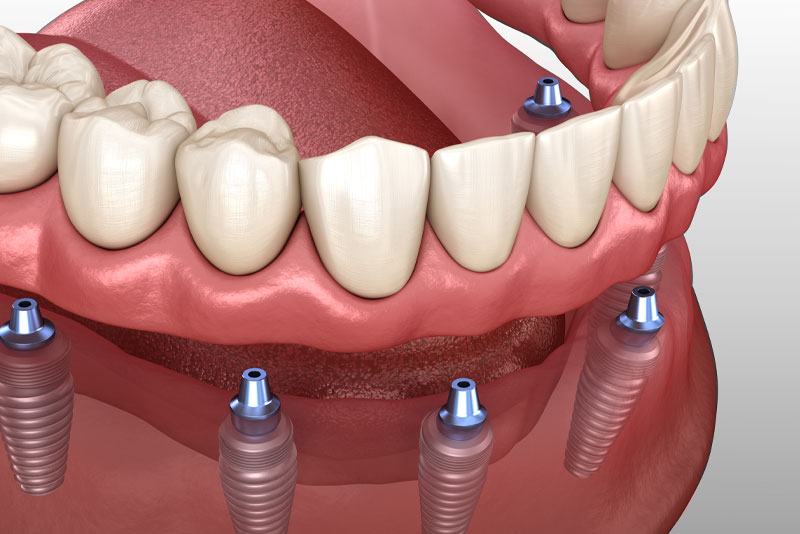
An implant-supported denture in Pickering appears similar to an ordinary denture, but instead of resting on your gums, it clips onto dental implants via special attachments on its fitting surface. These attachments correspond to special attachments on four or more dental implants, allowing you to snap them into place.
It is still a removable dental appliance, allowing you to snap it out for easy cleaning and to clean around the dental implants. However, once it is in your mouth, it will not move.
Other advantages of choosing implant-supported dentures in Brooklin include:
- Increased biting strength so you can enjoy more foods more easily.
- No sore spots created by loose dentures moving around on the gums.
- No need to use denture adhesive.
- Dental implants protect the bone around them, preventing resorption that occurs naturally after tooth loss.
- An affordable solution since relatively few implants are needed.
- We insert the implants towards the front of the jawbone, so it is unlikely that any other procedures like bone grafting in Courtice will be required.
- Most people are suitable for dental implants in Clarington.
- Dental implants are a long-term solution for tooth loss.
Disadvantages of implant-supported dentures can include:
- The cost of treatment is initially they are more expensive than ordinary dentures.
- Surgery is needed to insert the implants, although this is relatively quick and pain-free, especially as we can provide safe, effective sedation dentistry in Bowmanville.
- Treatment takes longer to complete, since the implants need several months to heal in the jawbone.
Guided Dental Implant Surgery to a Precise, More Comfortable Treatment
At Durham Dental Solutions, we utilize computer-guided implant surgery to plan and place every single implant. Using the most advanced technologies ensures you receive precision-planned and placed implants during a surgical procedure that is smoother and faster, enabling a more comfortable healing afterwards.
Are you ready to learn more? Call us to book your dental implant consultation today.